Monday, July 6, 2009

Lamborghini Gallardo BURNS In Greece!

We're not trying to start a flame war, but apparently after this weekend's Ferrari Enzo fire, the Italian boys from Sant'Agata wanted the world to know their ride was also pretty hot. Flame-broiled Lamborghini Gallardopictures below.
Location: Athens, Greece

Lamborghini's Murcielago replacement - The Jota V-12


Lamborghini recently launched its new LP670-4 SV, a car many believe to be the final evolution of the Murcielago platform, but work is already well underway for an all-new supercar set to arrive in just a couple of year’s time. This new Lamborghini will have some tough competition when it arrives as there are new supercar models in the works at rival brands FerrariMcLaren, and Aston Martin. While it’s still too early to speculate on the final specs, there are several crucial details we can gather from recent spy shots of a test-mule captured at Germany’s Nurburgring, as well as new reports coming out of Germany.

Mounted to each wheel of this test-mule is a RoaDyn torque sensor that is used to monitor the different forces and torque levels exerted on a specific wheel at different speeds. The data gathered can help engineers work out varying grip and traction levels in an effort to fine tune the vehicle’s AWD and suspension settings, and ride characteristics. 
Lamborghini’s next supercar will retain the Murcielago’s mid-engine layout but it will feature a wider track as evidenced by the extended fender flares seen on the test-mule. While power levels are usually boosted with each new model generation, for Lamborghini’s latest creation engineers are more likely to be focusing on reducing weight in their quest for increased performance. Thus, the new model will reportedly feature the Audi R8’s lighter aluminum space frame instead of the Murcielago’s steel tub design. 

According to Auto Motor und Sport, the car’s wheelbase will be similar in length to the Murcielago but its overhangs, both front and rear, will be much shorter. Expect plenty of carbon-fiber and other advanced composites in its construction as well.

A big-cube V-12 engine will likely remain but the addition of direct injection technology should improve fuel-efficiency and power levels across the rev-range. In this way, engineers will be able to improve performance without having to boost power, the end result of which will be a much easier to drive Lamborghini flagship. The 670hp (500kW) and 487lb-ft (660Nm) of torque developed by the latest Murcielago LP670-4 SV gives us a rough estimate as to what to expect. A dual-clutch transmission may also be offered to help transfer power to the four wheels. 

Lamborghini is yet to even reveal the car's existence but previous reports have speculated that it will be named the Jota and will bow in by early 2012. 

Saturday, July 4, 2009

Hamann Tricks Out The LP-640

It looks like a Stealth-Bomber on four wheels. It is one of the most masculine looking sports car and it is fast. The Lamborghini LP640 through its appearance gives a clear impression it's not just for show. Hamann decisively set its goal to send a clear message and sharpened the Italian steer's horns. Hamann's modifications through look, driving dynamics and sound create a distinct difference.

Maintenance of road contact is most essential when one is pushing a super sports car to the limit. To achieve greater downforce on the front and rear axle Hamann offers a front spoiler as well as a rear wing. Whoever prefers to show their affiliation to motor sports can order the parts in Carbon-Kevlar instead of the fiberglass version. Where's the starting grid?

Hamann applies further aerodynamic components in form of a two-part rear diffuser with additional air hoses for the extendable side air intakes, side sills as well as a two-part front wing and Carbon-pendants for the original side intakes in the sills in front of the rear wheels. Furthermore, a central running air box on the roof brings back memories of past Lamborghini Diablo GT-R days. Naturally, these parts are also available in Carbon-Kevlar or fiberglass.
Impressive Sound and Stunning Rims

The Hamann double-pipe stainless sports rear silencer (2x120mm end pipes) emits a sound similar to that generated from race tracks announcing the arrival of the blood-curdling steer. Positive side effect; an even sportier rear look. Export customers can extend their exhaust system with a Hamann sport metallic catalytic converter.

Also for individualization of vehicles within this high performance caliber, a choice of new wheel design is inherent. Hamann suggests its own creation "Edition Race". This multi-pieced, forged light alloy metal wheel with black wheel spider, "Y" spoke design, Titan bolts and high polished rim flange utilized for Lamborghini Murcielago LP640 comes in the combination 8,5Jx20" front and 13,0Jx20" rear. As expected, Hamann also offers here a complete wheel set with typical tires sizes 245/30 ZR20 and 335/30 ZR20.

Hamann prepares the cockpit of the Super-Lambo providing even more sports racing atmosphere. For this, the tuners from Laupheim, Germany, offer an 8-part carbon-look interior set. The race car look is established through instrument cockpit bordure, the air bleed jet, the gear shifting panel as well as the cigarette ashtray console. Naturally, Hamann offers each Lamborghini customer preferred alterations on an individual basis. For instance, extravagant leather furnishing in a variety of colors is possible or additional of multi-media articles.

Friday, July 3, 2009

Lamborghini CEO: Stephan Winkelmann

Stephan Winkelmann was born in Berlin and grew up in Rome, Italy. He studied Political Science in Rome and in Munich and started his career at a German finance company, after which he moved to Mercedes Benz. 

In 1994 he became Area Sales Manager for the Alfa Romeo brand within Fiat Automobil AG in Germany. Then, he became Fiat’s Head of Marketing, Southern Region.

From 1996, Winkelmann worked at Fiat Auto S.p.A. in Turin in Marketing and Sales management for Alfa Romeo, where he was responsible for the launch of the Alfa 156. He went on to become the Area Manager for several markets in Europe. After working as Board Member for Sales at Fiat Auto Austria, Winkelmann was appointed as Chairman of the Board at Fiat Auto Austria and later at Fiat Auto Switzerland. 

In 2004, he was named as Chairman of the Board of Fiat Automobil AG in Germany. On 1st January 2005, Stephan Winkelmann was appointed President and CEO of Automobili Lamborghini S.p.A. in Sant’Agata Bolognese (Italy).

2010 Lamborghini Murcielago LP-670-4 SuperVeloce

Automobili Lamborghini has now expanded its model range with a new, exceptionally purist and even more extreme top model – the Murciélago LP 670-4 SuperVeloce is even more powerful, lighter and faster than the Murciélago LP 640. With the output of the 6.5 liter V12 increased to 670 hp and a weight reduction of 100 kg (220 lbs), the Murciélago LP 670-4 SuperVeloce boasts a power-to-weight ratio of 2.3 kg (5.1 lbs) per hp. This catapults it from 0 to 100 km/h (62 mph) in a breathtaking 3.2 seconds and powers it on to a top speed of around 342 km/h (212 mph). Distinctive design refinements ensure that each of this 350-unit limited edition series conveys its full potential from the very first glance.

With its outstanding performance, razor-sharp precision and exceptional high-speed stability, the Lamborghini Murciélago LP 670-4 SuperVeloce is the ultimate performance car for advanced sports car drivers. The super sports car has been extensively redesigned with a new front and rear, an innovative engine bonnet and a choice of two aerodynamic set-ups featuring either a small or large rear spoiler. The interior in Alcantara and carbon fiber provides a purist and minimalist approach. 

In order to achieve the substantial weight reduction of 100 kilograms (220 lbs), the Murciélago LP 670-4 SuperVeloce was extensively reworked and redeveloped in virtually every aspect – from chassis to engine and transmission, right through to the interior. The increase in engine output from 640 to 670 hp is the result of optimized valve timing and a reworked intake system. The significantly modified aerodynamics with substantially increased downforce brings considerable improvement to vehicle stability at very high speeds. With the small standard-fit rear spoiler, top speed stands at 342 km/h (212 mph), while the large “Aeropack Wing” and its added downforce gives a top speed of 337 km/h (209 mph).

“The new Murciélago LP 670-4 SuperVeloce is the systematic continuation of our brand philosophy. It is more extreme and uncompromising than virtually any other automobile,” says Stephan Winkelmann, President and CEO of Automobili Lamborghini. “As the new top model of the highly successful Murciélago range, the SuperVeloce displays not only outstanding driving dynamics, it is also further evidence of our company’s technological expertise. Customers can look forward to an utterly unparalleled driving experience."
Design and aerodynamics

The Murciélago is an icon of the Lamborghini brand – a sports machine of menacing character and brutal power. Its unique design radiates a supreme form of highly concentrated sensuality. Wide, low, with its glass area pushed way forward and a long, taut back – the interplay between the soft contours of the basic form and razor sharp edges is the perfect expression of the Lamborghini design language. In the totality of its character, the Murciélago is without comparison on the sports car market.

Yet even a character like this can be further refined – the new Lamborghini Murciélago LP 670-4 SuperVeloce is the more extreme, even more purist pinnacle of the model range. This is clearly evident from the very first glimpse of its completely redesigned front end – pulled way forward and finished in matt black paint, the carbon fiber front spoiler is connected to the front end via two vertical elements. The large air intakes for the front brakes are more powerfully emphasized. The new front fenders feature additional air intakes for brake ventilation. The air vent for the oil cooler located in the driver-side sill area is painted matt black to match the sills.

The modifications are even more apparent around the mighty engine bay of the Murciélago LP 670-4 SuperVeloce. The twelve-cylinder engine is presented as an engineering masterpiece under a transparent engine bonnet that boasts a completely new architecture. Hexagonal polymer plates made from transparent polycarbonate are set on three levels within a carbon fiber framework. The layers are open towards the rear, playing a key role in the thermodynamics of the high-performance engine.

The impressive rear end of the SuperVeloce is dominated by a veritably noble, flat and extremely wide exhaust tailpipe and, on the underside, by a two-level diffuser system finished entirely in carbon fiber. The rear light clusters display their signals in that distinctive Y-shape that has been a fixed element of Lamborghini design since the Murciélago LP 640, Reventón and Gallardo LP 560-4. The panel between the lights is made from carbon fiber, while the large intake mesh below expands across the full width of the rear end. Made from thick-walled aluminum, the hexagonal pattern is laser-cut and a Teflon coating provides the necessary heat protection.

The aerodynamics of the Murciélago LP 670-4 SuperVeloce have been completely redeveloped. Alongside the enlarged front spoiler and the twin rear diffuser, the new fixed rear spoiler also plays an important role. Customers can choose between two versions, with the small rear spoiler providing improved downforce at high speeds. As an option, the Murciélago LP 670-4 SuperVeloce can be supplied with the “Aeropack Wing” – a large, fixed, carbon-fiber wing mounted on two carbon-fiber brackets. The new aerodynamic set-up provides a significant boost to directional stability at the very highest speeds. The top-speed downforce on the Murciélago LP 670-4 SuperVeloce with Aeropack is strongly increased.
Source: Lamborghini Press Release

2009 Lamborghini Gallardo LP 550-2 Valentino Balboni

He has long been revered as one of the many legends surrounding the world's most uncompromising sports car brand - Valentino Balboni, a remarkable test driver with his own personal cult status. Automobili Lamborghini now presents a model in his honour and bearing his name - the Gallardo LP 550-2 Valentino Balboni.
The latest version of the Gallardo, Lamborghini's most successful model of all time - overall, more than 9,000 units of the model range have already been produced - boasts not only its own distinctive design and exclusive equipment, but its technology is unique too, as indicated by the model badge: the 550 stands for the power output in hp and the 2 is for rear wheel drive.

For several decades, Valentino Balboni has had a distinct influence on the character of the super sports car bearing the sign of the bull. With his fine-tuning and testing work, he has helped to shape many automotive legends, from the Lamborghini Miura of the 60s through to the current Gallardo and Murciélago models. Balboni was hired in 1967 by company founder Ferruccio Lamborghini himself. From early on, it was evident that the young Balboni had a special feel for cars, that most sensitive of all instincts that connects to the 'life blood' of an automobile and defines the soul of a test driver.
"A Lamborghini must always combine the precision of a race car with the reliability of a good friend," says Balboni. Since 1973, he has sat at the wheel of every prototype built by the brand, and even most production cars have passed through his hands before being delivered to their customers. This has turned Balboni into one of the most important representatives of the brand, with an outstanding reputation and status among the brand's fans and customers worldwide.

Source: Lamborghini Press Releases

2008 Lamborghini Reventon


Clearly a 
Lamborghini, but nothing quite like it. A super car without equals: the Lamborghini Reventon is a road vehicle with an extreme specification and, at the same time, a limited edition masterpiece – a coherent style, angular with sharp lines, inspired by the very latest aeronautics.

With just 20 produced, each 1 Million Euro (without taxes) Lamborghini Reventon is a symbol of extreme exclusivity, yet still offering the extraordinary performance that makes the Reventon so unrivalled: under the completely autonomous design, the Reventon possesses the entire technical and dynamic competence of the twelve cylinder Lamborghini.


Lamborghini prides itself on being the extraordinary manufacturer of extreme super sports cars without compromise. Sensuality and provocation characterise every Lamborghini, with an aggressively innovative style. "However, the Reventon is the most extreme of all, a true automotive superlative. Our designers at the Lamborghini Style Centre took the technical base of the Murcielago LP640 and compressed and intensified its DNA, its genetic code," affirms Stephan Winkelmann, President and CEO of Automobili Lamborghini S.p.A.
Source: Lamborghini Press Releases

2008 Lamborghini Estoque Concept


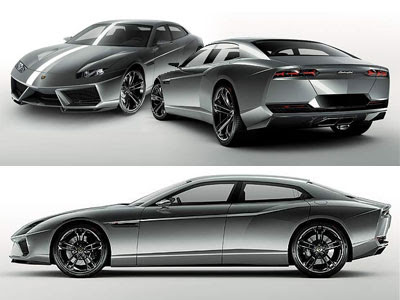
It is a Lamborghini like no other before it: a four-door sports car that sticks resolutely to its creed. The Lamborghini Estoque concept has everything that defines a Lamborghini: extreme, uncompromising and unmistakably Italian, iIt brings a whole new versatility to the brand's DNA – with its four seats and ample luggage space, this "everyday sports car" is a perfect fit for an equally versatile lifestyle.

Estoque is a study, a concept created specifically for the 2008 Salon d'Automobiles in Paris. From the very first glance there can be no doubt that this is a Lamborghini – a car with compelling presence, both unique and unmistakable. The long wheelbase, the low profile, the broad track, the mighty, accentuated wheels, the clean surfaces and razor-sharp definition – every single line breathes the spirit of the Lamborghini brand.
A new and unique elegance
The Estoque is an entirely new interpretation of the Sant'Agata design ethic: it is a concept that provides a clear indication of the future. This applies to the new, elegant self-confidence of the lines themselves, but even more to the concept of the vehicle. The Estoque is the first sedan in the history of Automobili Lamborghini, although "sedan" is more a reference to the number of doors than any other characteristics. Even sports sedan is an inadequate classification: the Estoque establishes a new category of super sports sedans. With a powerful front mid-engine, permanent all-wheel drive and a sophisticated, precision-tuned chassis; the Estoque boasts a unique technology package.

A sign of success
In Paris, the Lamborghini Estoque demonstrates the innovation, the creativity and the design flair of the Lamborghini brand, currently represented by the enormous success enjoyed by Lamborghini's Gallardo and Murcielago super sports cars.
As a concept, the Lamborghini Estoque represents one of several possibilities for a third model series within the Lamborghini product line-up. At this point in time, no decisions have been taken in respect of either a third model series of any kind or of the Estoque concept in particular.

Of course, as a true Lamborghini, it goes without saying that the Estoque also bears a suitably powerful name with a rich heritage from the Spanish Corrida – bull fighting. The Estoque is a rapier (sword), approximately 90 centimetres (35.43 inches) long, used in a bull fight by the Matador.

The Concept
Estoque embodies the concept of a Lamborghini that is both a dedicated sports car and a relaxed Gran Turismo. As a sedan with four doors and four individual sports seats, it is a multi-faceted vehicle for multi-faceted lifestyles.

Relaxed Gran Turismo
The Lamborghini Estoque is the perfect travelling companion, be it en route to business meetings, the theatre, the golf course or even a weekend away with the kids. At the end of the day, it is the only car that allows you to share the singular driving pleasure of a Lamborghini with more than one person – possibly even with the whole family. And there is still enough room left over for weekend luggage or several golf bags.

Despite its extremely low profile – at a mere 1.35 meters (4.43 feet) high – the Lamborghini Estoque is surprisingly spacious. The secret lies in its very long wheelbase which, in spite of the rearwards positioning of the front mid-engine, enables a relaxed, sporty seating position. Entering and exiting is also pleasingly straightforward through the large, wide-opening doors.

A challenging sports car
At the same, the Lamborghini Estoque is a thoroughbred sports car with exceptionally refined power delivery, razor-sharp precision handling and a meaty engine tone. Challenging driving pleasure on a winding mountain road, followed by a relaxed, enjoyable journey along miles and miles of motorway;– the Lamborghini Estoque is commanding across the entire driving spectrum., at the highest level. The Estoque's versatility makes it the perfect addition to the range of Lamborghini super sports cars.

Design
Such a Lamborghini must be immediately recognisable in its design as a unique and unmistakable work of art. For the Estoque, this is clearly a case of "mission accomplished."

The proportions of the Lamborghini Estoque are simply fascinating: no other automobile combines so convincingly the elegance of length with the sporting attributes of a low profile and impressive breadth. Or to put it into figures – the concept painted in an all-new colour, is 5.15 meters (16.89 feet) long and 1.99 meters (6.53 feet) wide, with a height of only 1.35 metres (4.43 feet). The wheelbase is a stately 3.01 meters (9.88 feet) – an equally important element of elegant vehicle architecture.

And it is unequivocally Italian – the flat bonnet, the long wheelbase, the narrow window openings, the flat rear that ends decisively with a negative return – it is all pure "Italianita" on wheels; everything bears the design language of the large classic Italian four-door cars, albeit with a unique, modern interpretation. Pure Lamborghini.

Clearly a sports car
The front end of the Estoque is a clear and unambiguous statement of its sports car credentials. Its place amongst the family of Lamborghini super sports cars is also distinct and unmistakable – with its swooping V-shape, its two large air intakes pulled forward and the small front spoiler in between. This front end design gives the Estoque a firm, low stance, while providing excellent aerodynamic efficiency. The large air intakes facilitate the cooling air that is important for such a high-performance vehicle and the spoiler was specifically designed to improve aerodynamic balance at high speeds.

Such distinctive sports car architecture is only possible by positioning the front mid-engine well towards the rear. Despite the very low bonnet, it goes without saying that the Estoque fulfils all safety regulations and pedestrian protection standards.

Taut muscles
The bonnet of the Estoque makes the origins of the sheer power of this vehicle immediately apparent. The location of the engine is clearly evident through the distinct division created by two large air outlets and the additional emphasis of a central power area. Further air outlets are positioned both left and right in the wings, behind each of the front wheel arches.

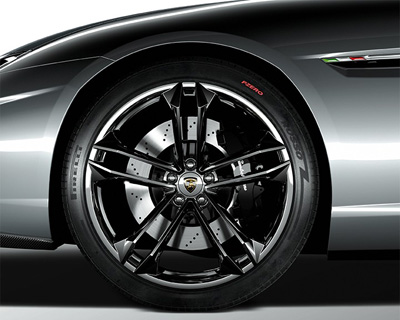
Together, with the division of the bonnet, these elements add emphasis to the area above the wheels, framing the front end of the Estoque like a taut muscle. The permanent all-wheel drive that is typical for all Lamborghinis means that the 22 inch wheels, with their new five double-spoke design, also do their part in delivering power to the road. Here too, the Centro Stile has stuck firmly to the Lamborghini principle that form always follows function; after all, the ample cooling air flowing into the high-performance driveline also has to move quickly out of the vehicle.

Tremendous tension along the flanks
Its proportions guarantee the Lamborghini Estoque an impressive appearance. The skilled sectioning along the flanks of the vehicle gives the body shell an incredibly muscular form. Beneath the flat surfaces of the bonnet, the incredibly powerful shoulder line, a further side line rising slightly towards the rear and, finally, the equally distinct sill line all add emphasis to the flow of power from the engine to the magnificent 23 inch rear wheels. The masculine profile is completed by the negative return of the rear end. This adds further tension to the form of the Estoque – the whole car looks coiled and ready to pounce at the drop of a hat. These sharp lines frame a fascinating interplay of surfaces across convex and concave curvatures. The Estoque clearly displays the design language of the Centro Stile Lamborghini with a distinctive elegance.

Powerful elegance at the rear
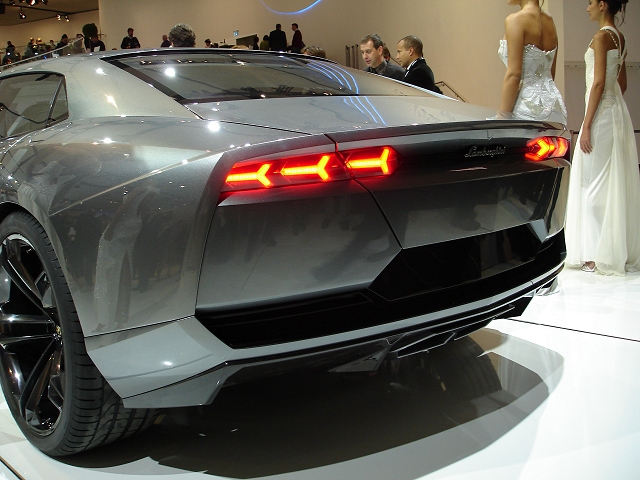
The flow of form is brought to its conclusion by the broad, even expanse of the rear end. The horizontal split created by the flat LED light clusters and the large, mesh-covered lower air outlets bring additional emphasis to this breadth. A narrow, slightly slanted "frame" panel surrounds the whole rear aspect and further highlights its powerful elegance.

Precise details, such as the hexagonal fuel caps on both sides of the vehicle, characterise the depth of the design language. The front headlamps, featuring bi-xenon and LED technology, carry forward a theme evident in both the Reventón and the Gallardo LP 560-4 – the Y-shape of the daytime running lights. The tiny green/white/red flag adorning the front wings discreetly highlights that an automotive statement as uncompromising as this one can come from only one country on Earth – from Italy.

The interior
Despite its extremely low profile, the Lamborghini Estoque offers a surprisingly generous feeling of spaciousness. The length of the interior facilitates a relaxed seating position for all four individual seats and plays a significant role in the supreme comfort of this super sports sedan over long distances. The interior reflects elements of the exterior design language, also evident in the cabin of the Estoque – in the distinctive lines of the door panels or in the swooping V-shape applied to the cockpit, reflecting the form used on the front end and on the bonnet.

Luxurious interior
The dominant material of the interior is highest-quality Nappa leather. The four individual seats boast sporting contours, supreme long-distance comfort and extensive electrical positioning options.

Cockpit with large-screen display
The cockpit presents the driver with a large-area LCD screen displaying vehicle and route information. A range of presentation formats are available for selection depending on personal preference – a distinctive classical layout with circular instrument dials, or an innovative digital display. A top-class audio installation and a sophisticated rear seat entertainment system round off the equipment.

Like the interior, the luggage compartment of the Estoque is also surprisingly spacious. Despite the low-profile rear end, it has plenty room for several golf bags or pieces of luggage.

Production feasibility
As a pure concept car, the Estoque is a design exercise and a further indication of the innovative power of the Lamborghini brand. Yet, it is based on a feasible technical concept that offers a whole range of fascinating alternatives for the body shell and driveline.

Just like the brand's super sports cars, the Estoque uses a mid-engine layout. However, the high-performance driveline used here is not located in front of the rear axle, as in the Gallardo and Murcielago or in the Reventon, but behind the front axle. This front mid-engine concept, with the driveline set way back, facilitates balanced weight distribution and a centre of gravity close to the vehicle's vertical axis. Both ensure the unparalleled agility and handling precision of a mid-engine vehicle.

Reserves in every situation
Like all contemporary Lamborghini models, the Estoque is also equipped with permanent all-wheel drive. It distributes the engine power to all four wheels, thus making for superior traction in all driving situations, as well as providing extra reserves for extremely sporty driving and for challenging weather conditions.

A range of drivelines is conceivable for the Estoque. This is headed up by the highly-acclaimed Lamborghini ten-cylinder from the Gallardo LP 560-4 – with more torque and higher revving than virtually any other engine. A complementary alternative could be a turbocharged eight-cylinder derived from this V10. A particularly economical, but nevertheless dynamic, variation would be a V8 with a hybrid module or an extremely high-performance TDI.

The Centro Stile Lamborghini
With the Estoque, the Centro Stile Lamborghini has created further proof of its creativity and attention to detail. The design centre that opened in 2004 is a studio of creatives, designers and model makers that combines the culture and the spirit of the brand with the power of innovation and of creating a new aesthetic. The Centro Stile Lamborghini is part of the best tradition of Italian vehicle design, and is leading the way forward with the latest in working techniques.

The Centro Stile is located in a 2,900 sq. metre (31,215 sq. feet) facility, where it occupies two interconnected floors. The generously proportioned design studio is equipped with two full-size surface tables and their associated tooling and measuring equipment, while further areas house the latest in computer workstations for the creative experts and a workshop for the model makers. The Centro Stile is also connected directly to the neighbouring Ufficio Tecnico – the direct link to Lamborghini's development department ensures the rapid realisation of ideas. Speed is a key aspect for Lamborghini, for both its cars and its working processes; the Reventon was created in the record time of less than one year.

In-house creativity and implementation
From the first sketches made either on paper or using the three-dimensional computer program, through 1:10 or 1:4 scale models to full-size models, the complete design process is organised within small, fast-moving teams.

Since it was founded, the Lamborghini brand has been bringing innovative design trends to the rarefied atmosphere of the world's most desirable automobiles, and producing vehicles with absolutely unmistakable character. Models such as the Miura and the Countach were way ahead of their time, but quickly attained the status of timeless classics. From their first appearance, every new Lamborghini is destined to become a legend and sought-after collectors' item.

With the current Murcielago and Gallardo, Lamborghini has once again perfected an innovative design language. The exterior proportions provide an indication of the power and dynamic character of the driveline. Crisply-defined edges, precision lines and clean surfaces result in a design that is reduced to its very essence.
Every element is designed precisely in accordance with its function. Examples of this on the Murcielago LP 640 include the movable cooling air intakes and the asymmetric sills; on the left side of the vehicle, the air intake is significantly larger to accommodate the flow of fresh air to the oil cooler.

Clear lines, perfect details
The unmistakable form of a Lamborghini is something that always speaks for itself: ornamentation or decoration of any kind has absolutely no place here. This firmly places the current models that bear the sign of the bull within the best traditions of their brand and of 60s and 70s Italian vehicle design. The sports cars of that time were acclaimed for their perfect proportions and for their objective, functional elegance that required no embellishment of any kind.
The purist execution of the lines is complemented perfectly by the passion for detail possessed by the designers in Sant'Agata Bolognese. The rear view of the Murcielago LP 640 is distinctive not only for its impressive power, but also for the fine interplay of the elements in the sophisticated rear light cluster.

The sensuality of precision and performance
A Lamborghini is a high performance athlete. Its high degree of sensuality is based on precision, performance and spontaneous action. This type of elegance is the elegance of pure, unadulterated power. This Lamborghini DNA is carried forward into future products at the Centro Stile, which is destined to continue to set clear design trends – the Estoque is the perfect example.
The design centre on the site of the historical birthplace of all Lamborghinis guarantees the super sports cars with the bull brand will remain exclusive, sensual and challenging – and always unmistakably Italian.
Source: Lamborghini Press Releases

2009 Lamborghini Murcielago LP650-4 Roadster - 650 hp

Automobili Lamborghini has released the first photographs of a limited edition Murcielago LP650-4 Roadster. The Roadster version of the Murcielago will offer an uprated 6.5 litre V12 engine that produces 650 hp (478 kW) along with permanent four-wheel drive: hence the model's LP650-4 moniker. With 660 Nm of torque, top performance is at 0-100 km/h (0-62 mph) in 3.4 seconds. The top speed is around 330 km/h (205 mph).
The special edition model will be produced in a limited volume (50 units only), with a Grigio Telesto exterior that combines grey bodywork with a special bright orange Arancio LP650-4 featured on the front spoiler and sills. The LP650-4 logo applied to the car's exterior is recognition of the car's increased power. The car features orange brake callipers and a transparent V12-engine cover, which shows off the V12 engine behind the driver.
Interior features echo the car's striking grey-and-orange exterior: besides the orange touches, there is an asymmetric dash design, with black Alcantara Nera on the driver's side, including door panel and central tunnel, and black leather Nero Perseus on the passenger's side.
The increased power of the Murcielago engine, from 640 hp to 650 hp, will be unique to the Murcielago LP650-4 Roadster: it demonstrates even further the developments that Lamborghini is able to offer from a current engine, and creates the exclusive characteristic of the Murcielago LP650-4 Roadster.
Source: Lamborghini Press Releases

2009 Lamborghini Gallardo LP560-4 Polizia - 552 hp & 398 lb-ft


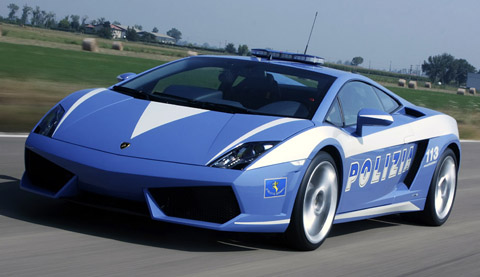
A private ceremony was held today at the Viminale Palace where Automobili Lamborghini S.p.A. donated a police version of the company's newest super sports car, Gallardo LP560-4 Polizia, to the head of the Italian State Police, Prefect Antonio Manganelli.
The new Gallardo LP560-4 Polizia, which replaces the previous Gallardo in use by the Italian police force since 2004, has a 560 horsepower engine that can reach speeds of up to 203 mph. The car will begin service with the Lazio Highway Police Department in order to continue accident and crime prevention to sustain security on the Italian roads.
Its predecessor is proof of Lamborghini's outstanding product quality. Since 2004, Rome's police force has had the first-generation Gallardo in regular police service. The sports car has clocked nearly 87,000 miles of patrol duty on the motorways of central and southern Italy, as well as on emergency medical transport detail.

A second Gallardo, painted in blue and white police colours, has been in service around Bologna, Italy since 2005. Its odometer already shows more than 62,000 miles. Aside from regular servicing, neither of the super sports cars has required major repairs.
In addition to the clearly effective deterrent offered by the presence and visibility of a Lamborghini on the highway, the technological equipment on board these vehicles makes them highly effective in the control of hazardous behaviour on the roads (high speeds, driving in the emergency lane, dangerous over-taking); the automatic recognition of number plate tracking and real-time transmission of images to the control rooms.
The cabin of the super sports car is fitted with the latest advancements in police technology to immediately document the evidence of any transgression. The video system is positioned in the center of the cabin with a camera fitted next to the rear view mirror and a computer and recording equipment behind the seats. As soon as police officers discover a suspicious driver, they activate the "Proof Video Data System." With the help of GPS data, the device can calculate the location, direction of movement and speed of the Lamborghini. This combined with the distance and time before intercept, accurately determines the speed of the vehicle being pursued.

Using radio data transmission, the video system in the Gallardo Polizia transfers its images in real time to the relevant police station. There, the videos are stored and used for automatic number plate retrieval. This information can be used for immediate identification of stolen vehicles.
In addition to its high tech equipment, the Gallardo is also fitted with the "classic" array of police equipment, such as a gun holster, police radio equipment and the "Paletta," the traditional hand-held stop sign used to advise motorists and traffic offenders to pull over. Officers can then use a removable screen to show offenders their misdeeds immediately, complete with an overlay of all the associated data.

The Lamborghini is used regularly for urgent medical transportation too. The luggage compartment in the front of the vehicle is equipped with a specialised refrigeration system for safe transportation of donor organs. For extreme emergencies, there is also a defibrillator used to restore a normal heart rhythm to patients by delivering an electrical shock to the heart to stop massive cardiac arrhythmia or ventricular fibrillation, and thus save lives.

The 30 police officers permitted to drive the Gallardo Polizia receive special training in the use of the Gallardo's medical equipment. Each person on the special operations team – which includes three women – has undertaken several days of driver training with Lamborghini, under the leadership of the Lamborghini test drivers. The basis of trouble-free everyday operation is the exceptional safety of the Gallardo LP560-4 with its permanent all-wheel drive and its refined chassis, which maintains stability even at the highest speeds. Lamborghini's extremely high standards for product quality and reliability ensure that the Gallardo LP560-4 Polizia is always ready for duty.
Now the successor is ready – a new generation Gallardo LP560-4 with the very latest in special equipment. The Lamborghini wears its uniform with pride, painted in accordance with requirements in "blu Polizia" – whereby the white stripes and lettering follow the Gallardo's dynamic design angles. Its main patrol beat will once again be central and southern Italy, primarily on the motorway between Salerno and Reggio Calabria.
lamborghinigallardolp56gk6.jpg
The police beacon on the roof of the Gallardo had to be aerodynamically optimised being that the new police car reaches a considerably higher top speed than regular service vehicles. Despite the extremely flat construction of the signal lighting, blue LEDs are fitted round the base to ensure the visual signal cannot be missed. The roof-mounted lighting is supported by further blue LED signals on the front, sides and rear of the light's aluminium shell. A total of four sirens integrated into the front and rear of the Gallardo generate unmistakable audible warning signals.

Just like its predecessor, the new Lamborghini Gallardo LP560-4 Polizia is destined to be not only the fastest, but also the most famous police car – even beyond Italian borders.
The Italian State Police uniform, and the unquestionable attraction of the Lamborghini brand, continue to arouse curiosity and interest. Thousands of citizens have the possibility to see the car for themselves during the many events organised to promote the vehicles in use.
Alongside its daily operational duties, the Gallardo also has regular public appearance obligations, such as its role as parade leader every year in Rome's traditional "Festa di Polizia," or its escort responsibilities at events with historical vehicles, like the Targa Florio and the Milan – San Remo Rally. Its predecessor even represented the Italian police in New York City at the 2005 "Columbus Day" parade.
Source: Lamborghini Press Releases

2009 Lamborghini Gallardo LP560-4 Spyder - 552 hp & 398 lb-ft

2009 Lamborghini Gallardo Spyder LP560 4 Rear Three Quarters View Top Down
Automobili Lamborghini, creator of the world's most exclusive super sport cars, today held the worldwide debut of the Lamborghini Gallardo LP560—4 Spyder at the Los Angeles Auto Show. As the successor to the best-selling Lamborghini of all time, the new LP560-4 Spyder combines the Coupe's design, performance and handling characteristics with the open-air pleasure only a soft top super sports car can deliver
2009 Lamborghini Gallardo Spyder LP560 4 Side View Top Up
As the brand's largest global market, the United States – specifically Southern California - was strategically chosen as the perfect location to unveil the new open top super sports car. In 2007, Southern California contributed to approximately 30 percent of all Lamborghini sales in the United States, maintaining its position as the country's most successful region.

"The new LP560-4 Spyder adds another dimension to the Gallardo's lineage with extreme design language and class-leading performance," says Stephan Winkelmann, President and CEO of Automobili Lamborghini. "The open version of the successful Gallardo LP560-4 is the result of Lamborghini's two model strategy including the Gallardo and Murcielago."

The much anticipated Gallardo LP560-4 Spyder offers a new 5.2 litre engine with 40 additional horsepower than its predecessor; allowing it to sprint from 0-62 mph in only four seconds with a top speed of 201 mph. The car's agility has also been greatly refined with a new, lighter transmission, which allows increased shift times by 40 percent (Corsa Mode), combined with an all-new chassis, suspension and Lamborghini's permanent all-wheel drive system. Despite increased performance, fuel consumption and CO2 emissions have been reduced by 18 percent.
2009 Lamborghini Gallardo Spyder LP560 4 Cockpit View
Since 2003, more than 8,500 Gallardos have left the production facility in the birth place of all Lamborghinis in Sant'Agata, Bolognese, Italy. The Gallardo LP560-4 Coupe was first unveiled to the world at the Geneva Motor Show in 2008 with the dynamic launch taking place in Las Vegas later that spring. Each person who experienced the new Gallardo on the track or the streets unanimously agreed: the Gallardo LP560-4 is an all-new car that can be enjoyed on any driving surface. Since, the new Gallardo has been critically acclaimed by customers and the media for its extreme performance, aggressive design and increased drivability. The highly anticipated LP560-4 Spyder is set to continue this legacy. The Gallardo LP560-4 Spyder will be available in Lamborghini authorised dealerships in the spring of 2009 for USD$221,000 (MSRP).
2009 Lamborghini Gallardo Spyder LP560 4 Interior View
In 2007, the United States market accounted for 39 percent of total Lamborghini sales worldwide and remains the brand's largest global market. Since the beginning of 2005, Automobili Lamborghini has strategically increased its global reach from 65 to 121 dealers worldwide; 31 of these dealers are located in the United States. Last year was a record year for the brand with 930 Lamborghinis delivered in the United States and 2,406 delivered worldwide.
Source: Lamborghini Press Releases

2007 Lamborghini Murcielago LP640 Roadster


Lamborghini is presenting the new version of the Lamborghini Murcielago Roadster at the 2006 Los Angeles Auto Show. The Lamborghini Murcielago LP640 Roadster benefits from the same extensive modifications to the bodywork and mechanics as the LP640 Coupe, as well as delivering its own distinct character.

In their reinterpretation of the Roadster, the designers of the Lamborghini Centro Stile have remained true to the original style principles of purism, sportiness and functionality. As with the Coupe it has now assumed a more aggressive appearance, a substantial influence being the new front and rear bumpers. On the latter there is a new rear diffuser, in which the exhaust system is integrated within a tailpipe. The rear lights are also new, increasing the distinguishing features and making the Murcielago Roadster as unmistakable at night as in daylight. The asymmetrical design of the sides is particularly striking. Whilst the area behind the air inlet on the right is almost closed, on the left there is a large opening for the ventilation of the oil cooler. This, in addition to the aerodynamic form of the front and rear, is an illustration of how functionality dictates the shape of a Lamborghini.

Changes to the rear view mirror make the Murcielago Roadster more aerodynamic, with other features including new windscreen wipers and the option of new Hermera alloy wheels.

From its forerunner, the Lamborghini Murcielago Roadster LP640 has inherited the characteristic asymmetrical interior arrangement. The whole interior is tailored to the driver and arranged in such a way that a true driver focused experience is offered; a car which challenges yet at the same time is entirely geared to the driver. This is illustrated in the use of perforated leather for the chair cushions, the dashboard tunnel console and the door lining on the driver's side.

The instrument panel has also been redesigned with different display graphics. This includes a new Kenwood car radio with a 6.5 inch widescreen monitor and reader for DVD, MP3 and WMA. The navigation system (standard equipment in Japan) is also available as an option.

Like its predecessor, the Murcielago LP640 Roadster can be customised through special equipment packages. The 'ad personam' individualisation program offers even more scope to create a personal, unmistakeably individual sports car.

As with the Coupe the new 6.5 litre 60 degree V engine and 640 PS (471 kW) at 8,000 rpm is now used also in the Lamborghini Murcielago Roadster. At 6,000 rpm the 12 cylinder engine reaches the maximum torque of 660 Nm. Naturally the Lamborghini Murcielago meets all the current valid European and North American emission standards.

The increased power naturally leads to increased road performance. The maximum speed now lies at 330 km/h compared to 320 km/h. The standard sprint from 0 to 100 km/h is now reached by the Murcielago LP640 Roadster in an excellent 3.4 seconds making it 0.4 seconds faster than its forerunner.

The engineers also focused their attention on optimising the torque band. The driveability of the engine thus benefits from the use of a continually variable timing system (intake and exhaust side) and engine management with Drive by Wire System.

In order to meet the increased thermal requirements of the engine, the engineers built a larger oil cooler. On the exterior this is illustrated by a larger air inlet on the left wing of the vehicle. The liquid cooler on the other hand remains unchanged with the Lamborghini VASC System (variable geometry air inlet system). Additional electronically controlled air scoops open according to the outside temperature and cool air requirement. This guarantees maximum aerodynamic efficiency.

Higher performance and torque naturally mean increased demand on the drive components. A six gear transmission adapted to these requirements, plus a stronger rear differential and new half axles, have therefore been deployed in the new Murcielago Roadster. An e-gear transmission with a newly tuned thrust mode (acceleration program) is also available as an option.

Like its forerunner, the new Murcielago Roadster LP640 has permanent four wheel drive. This is based on Lamborghini's proven VT system (Viscous Traction), which is self regulating without the aid of electronic controls. In standard cases the drive force is distributed between the front and rear axles at a ratio of 30 to 70. An independent control loop adjusts the distribution of the drive force depending on dynamic oscillation, weight distribution and the relative friction values in synchronisation with the Visco clutch. In extreme cases, up to 100 percent of the drive force can thus be applied to one axle.

Innovations have also been made to the electronics. With a closed loop control system the revised electronic control units improve the road performance and the response characteristics of the engine. All engine and vehicle parameters are controlled and monitored through a combination of three 'master' and one 'slave' control units. These are two electronic control units of the Lamborghini LIE type: a Lamborghini GFA (Gestione Funzioni Ausiliarie, ie. Auxiliary Function Control) control unit and a Lamborghini PMC (Power Motor Control, ie. slave unit). These control units are interconnected by means of a CAN bus.

Although the Lamborghini Murcielago Roadster LP640 is principally based on the Murcielago Coupe, it has further distinguishing features beyond its distinctive appearance. First and foremost, newly designed frame structure parts made of steel and carbon fibre guarantee an unswerving torsion resistance even without a roof. A special reinforcement structure in the engine area makes a major contribution to this aspect. This optically distinctive reinforcement can also be delivered in carbon fibre on request. Without impairing the extreme character of a typical roadster, a canvas roof (R.top) can be fitted which, true to the design tradition of this type of vehicle, is principally conceived for temporary use (for example in a sudden shower of rain) and for speeds of up to 160 km/h.

With its characteristic wing doors, the bodywork of the Murcielago LP640 Roadster is still made from an extremely high quality combined structure of sheet steel and carbon honeycomb. The combination of these materials is achieved by bonding and riveting.

The road performance, handling and stability at high speeds benefit from the use of new springs and stabilisers as well as the revising of the electronically controlled silencers. The anti dive and anti squat properties of the axles which effectively prevent brake diving and squatting, remain unchanged. The springs (two for each rear wheel and one for each front wheel) and silencers are coaxially aligned.

The new aluminium Hermera rims measure 8.5″ x 18″ at the front and 13″ x 18″ at the rear. The vehicle is equipped with mixed tyres of the type PIRELLI P Zero "ROSSO". The Murcielago LP640 Roadster is driven at the front on tyres with the dimensions 245/35 ZR 18 and 335/30 ZR 18 at the rear. Pirelli P Zero Corsa tyres are available as an option which are particularly appropriate for use on race tracks.

It goes without saying that a super sports car such as the new Lamborghini Murcielago LP640 Roadster goes hand in hand with a high level of safety.

Its hydraulic dual circuit braking system with LP brake servo (unit) ensures impressive delay values under even the hardest strain. The internally ventilated brake disks measure 380 mm x 34 mm at the front and 355 mm x 32 mm at the rear. The closed loop of the four channel anti lock braking system (ABS) is enhanced, with electronic braking management (DRP) and traction control (TCS). The system consists of an electro hydraulic control unit and four sensors for the wheel speeds.

When extremely high performance braking is required it is possible to equip the vehicle with carbon ceramic brakes measuring 380 mm x 36 mm with six piston-brake callipers, which reduce pressure on the brake pedal and shorten the braking distance. Even under the toughest strain, there is almost no brake fading. Substantially reduced weight and greater durability are further advantages in addition to the carbon ceramic brakes' attractive appearance.

The new Murcielago LP640 Roadster meets rigorous standards in terms of passive safety. With two front seat air bags, a 60 litre airbag on the driver's side and a 130 litre airbag on the passenger side, it meets all existing world wide standards in the event of head on and side crashes, impact against poles, occupant safety in the case of accident, fuel supply integrity and fuel combustibility. The luggage compartment also complies with childproof safety regulations. The Murcielago LP640 Roadster has automatically lowered roll bars; if the electronic control of this device detects a critical situation, the roll bars shoot out behind the seats within just a few milliseconds.
Source: Lamborghini Press Releases